Launch offer — valid today only

📄 Digital book in PDF · read it on your phone or print it

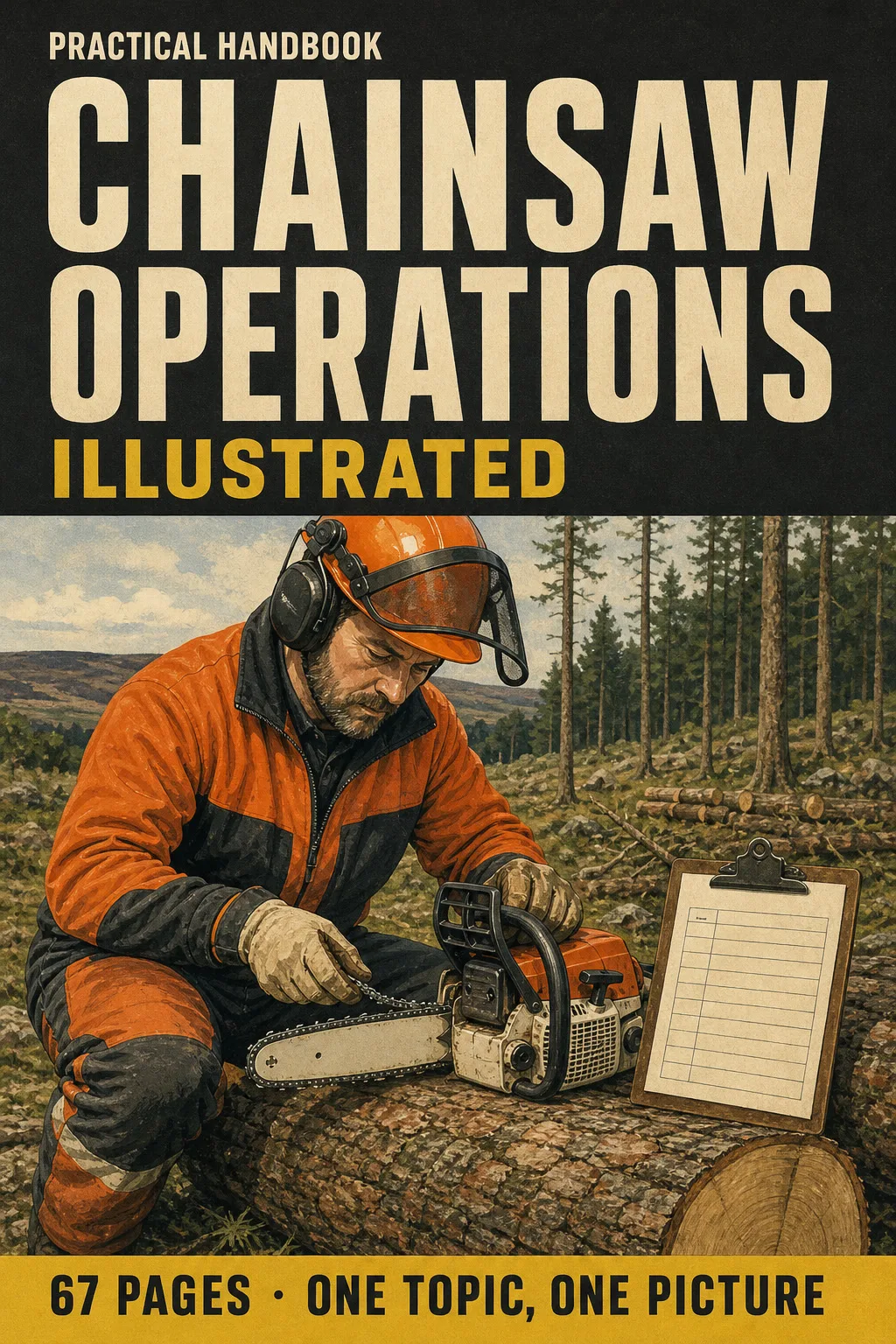
The Chainsaw Course in Drawings Every Check and Every Cut, Always in the Same Order

For the QQI Level 5 chainsaw course in Ireland. Parts of the saw, the kickback zone, chainsaw trousers, two-stroke mix, chain filing, the ground start, cross-cutting, the notch and the hinge: each one on its own page, the drawing first, then the numbers to remember. 67 illustrated pages.

I WANT THE ILLUSTRATED BOOK

🔒 Secure checkout · PDF by email · 30-day guarantee

Every topic, its own pageEach check and each cut drawn, with the explanation beside it
67 illustrated pages9 parts, from the parts of the saw to assessment day
Up-to-date sourcesHSA guidance, the Safety, Health and Welfare at Work Act 2005 and the General Application Regulations 2007
PDF by emailFormat

Look Inside the Book

Every page has one large drawing and a box with the numbers and steps you need to know:

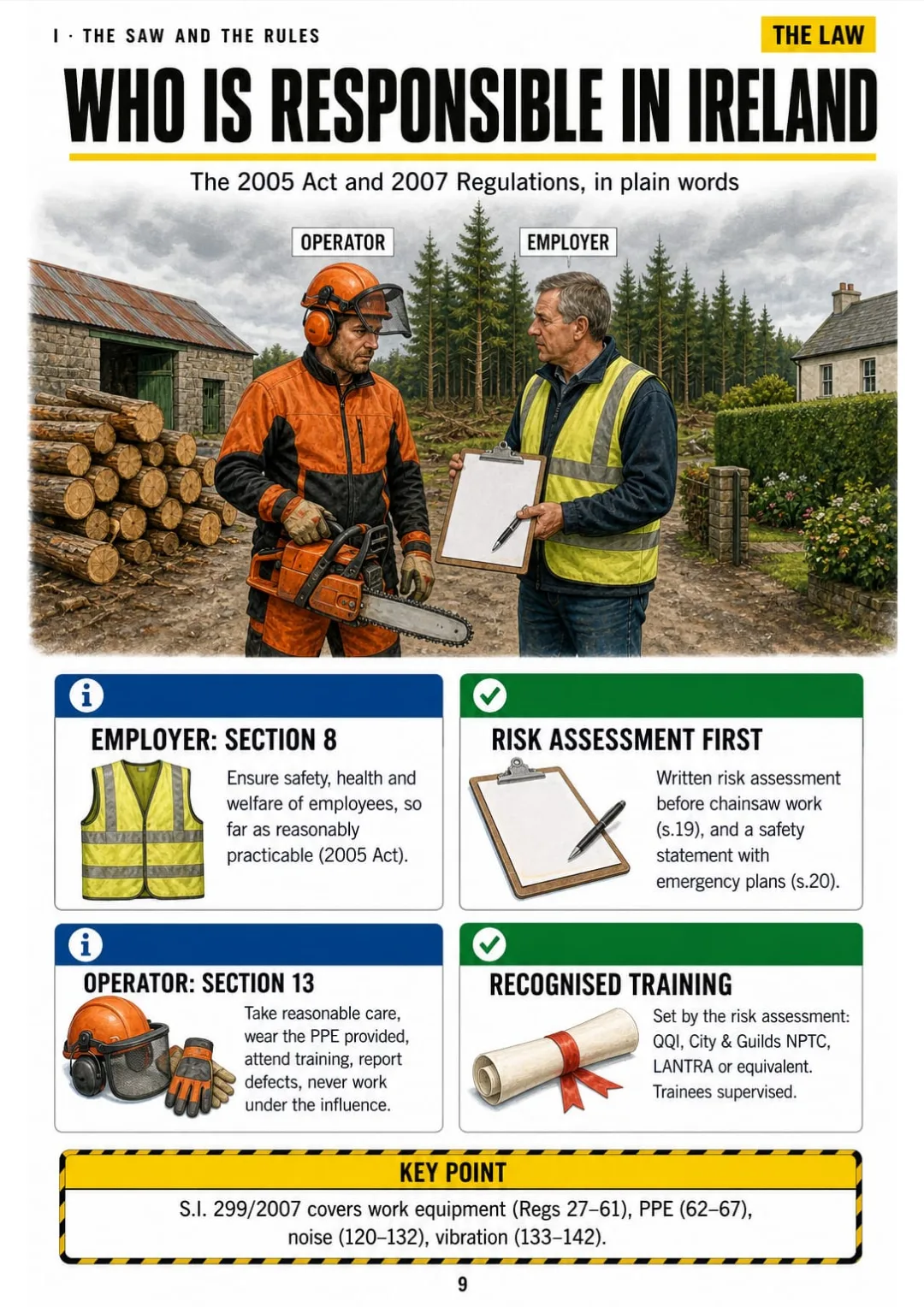
2005 Act ss.8, 13, 19–20 and S.I. 299/2007: who does what before the saw starts.
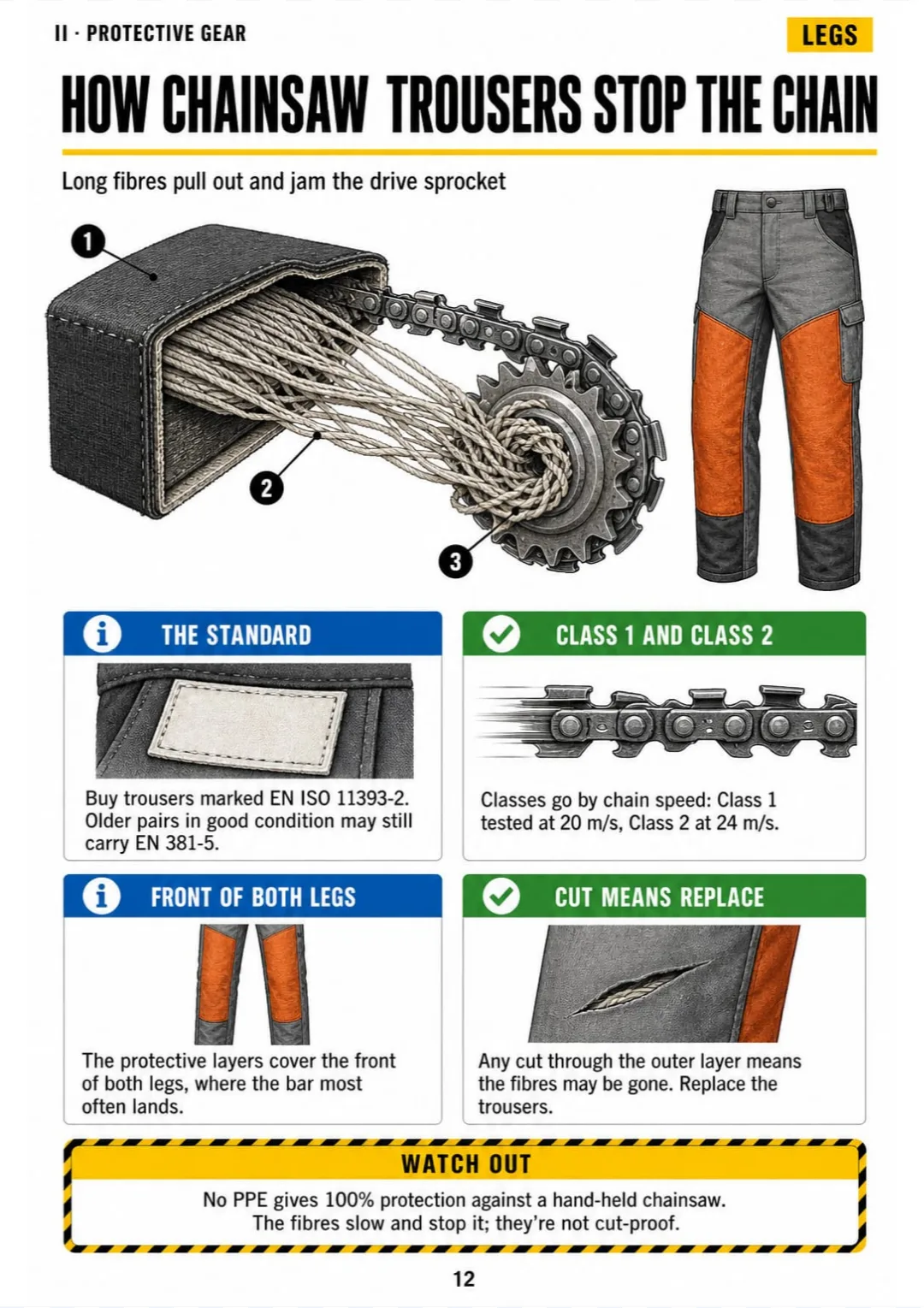
Clogging fibres jam the sprocket: EN 381-5 or EN ISO 11393-2, Class 1 = 20 m/s.
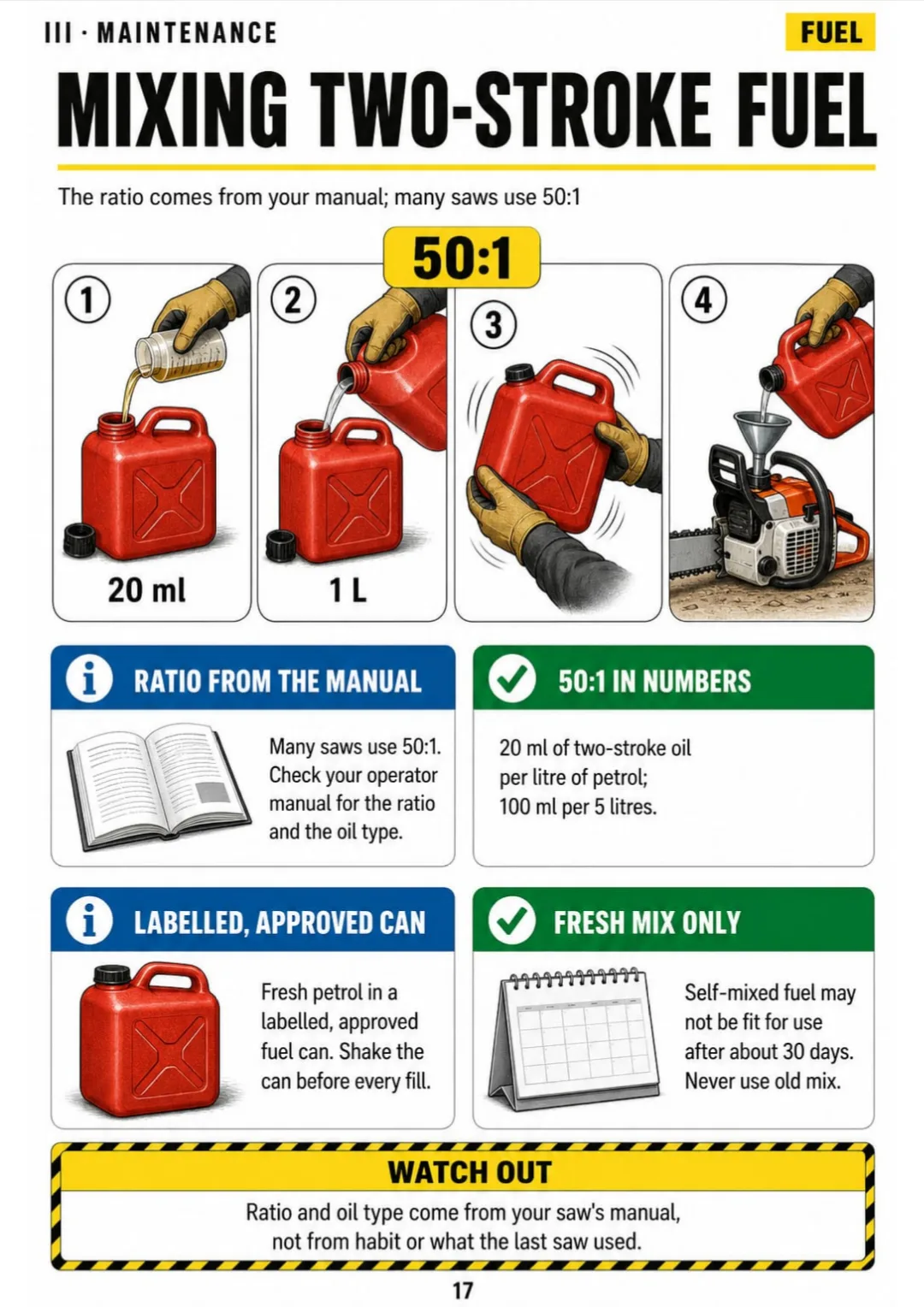
50:1 = 20 ml of two-stroke oil per litre of petrol; fresh mix, labelled can
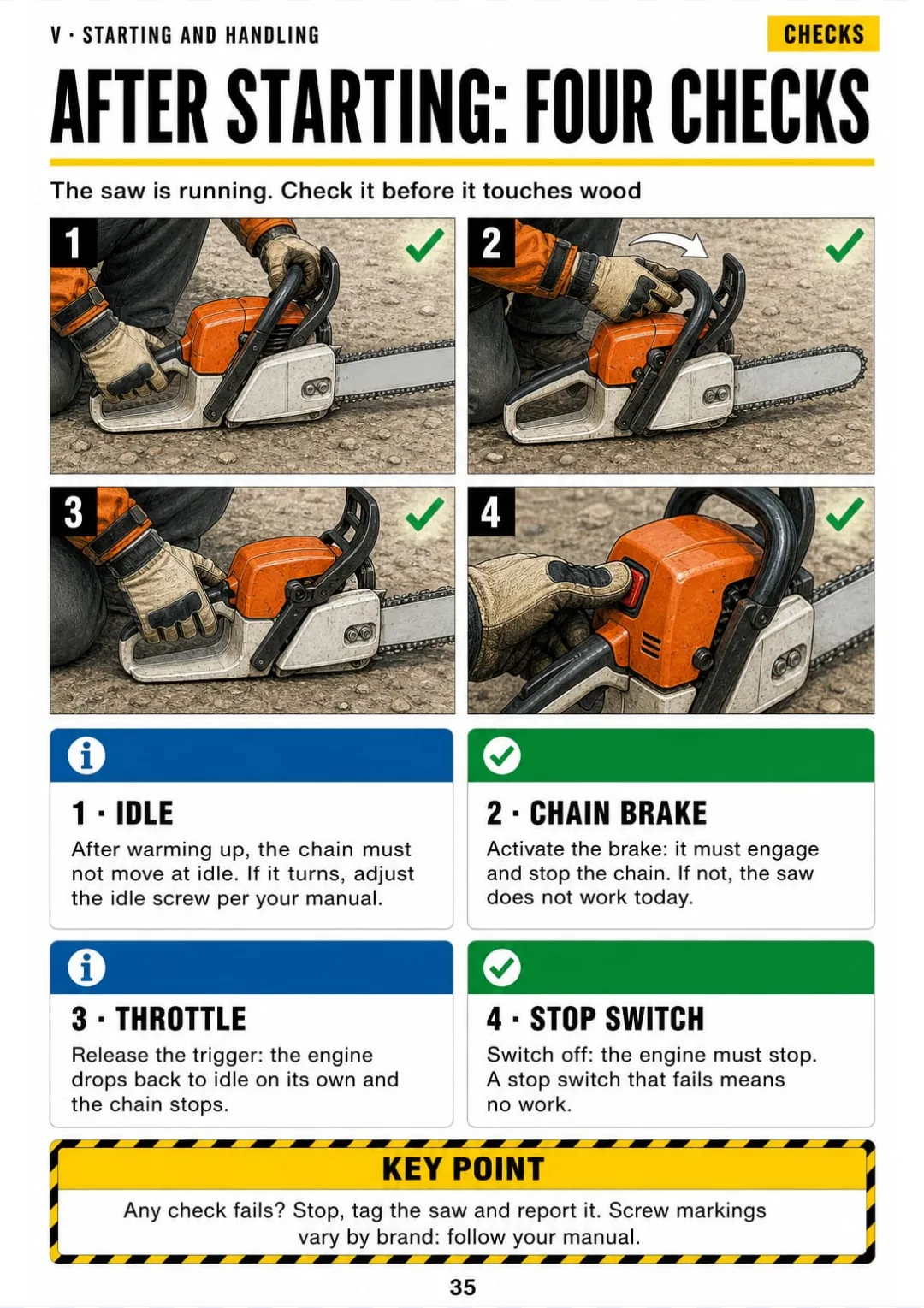
Four checks after starting: still chain at idle, brake stops it, throttle returns, stop switch works
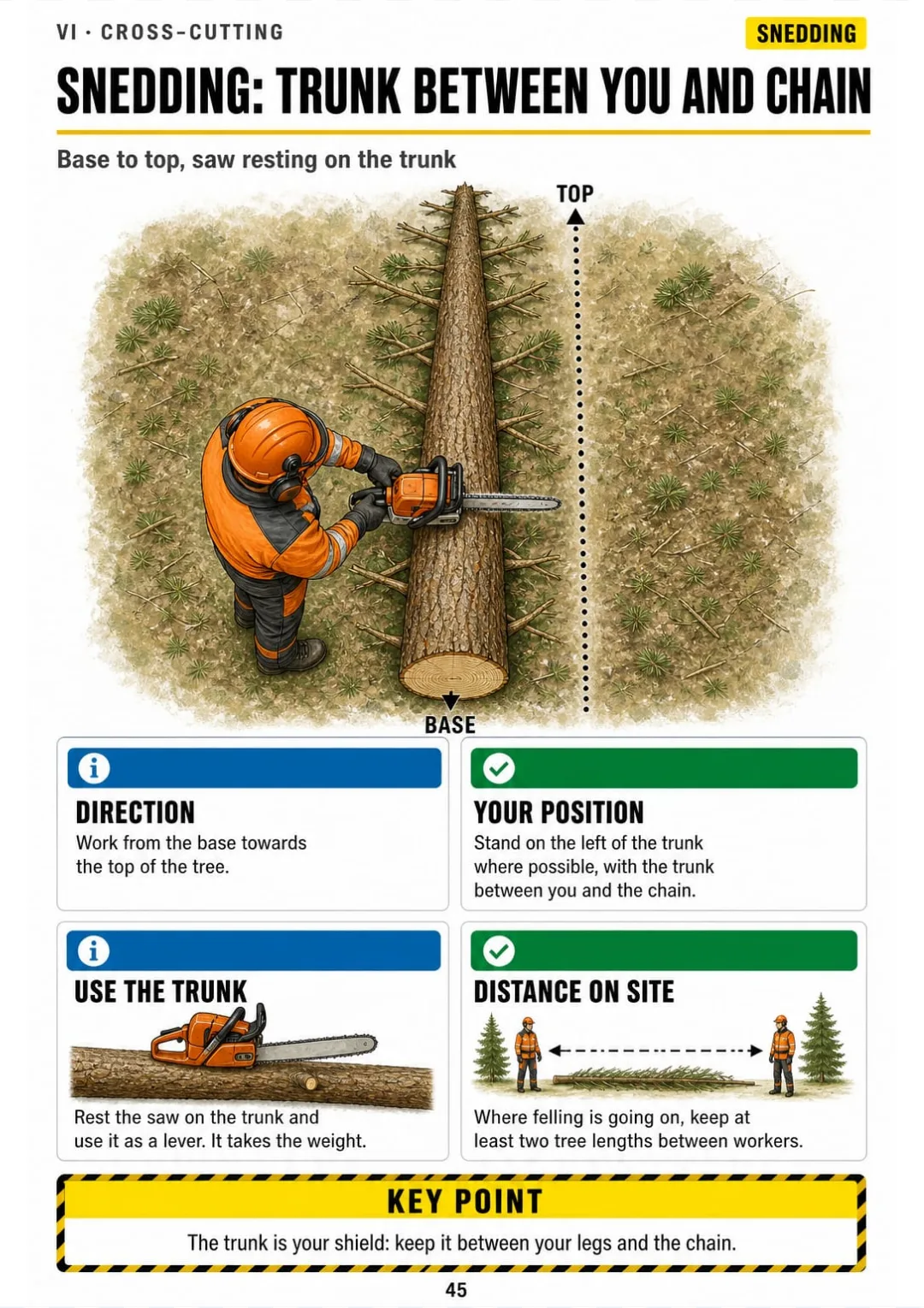
Sned from base to top, stand on the left, rest the saw on the trunk.
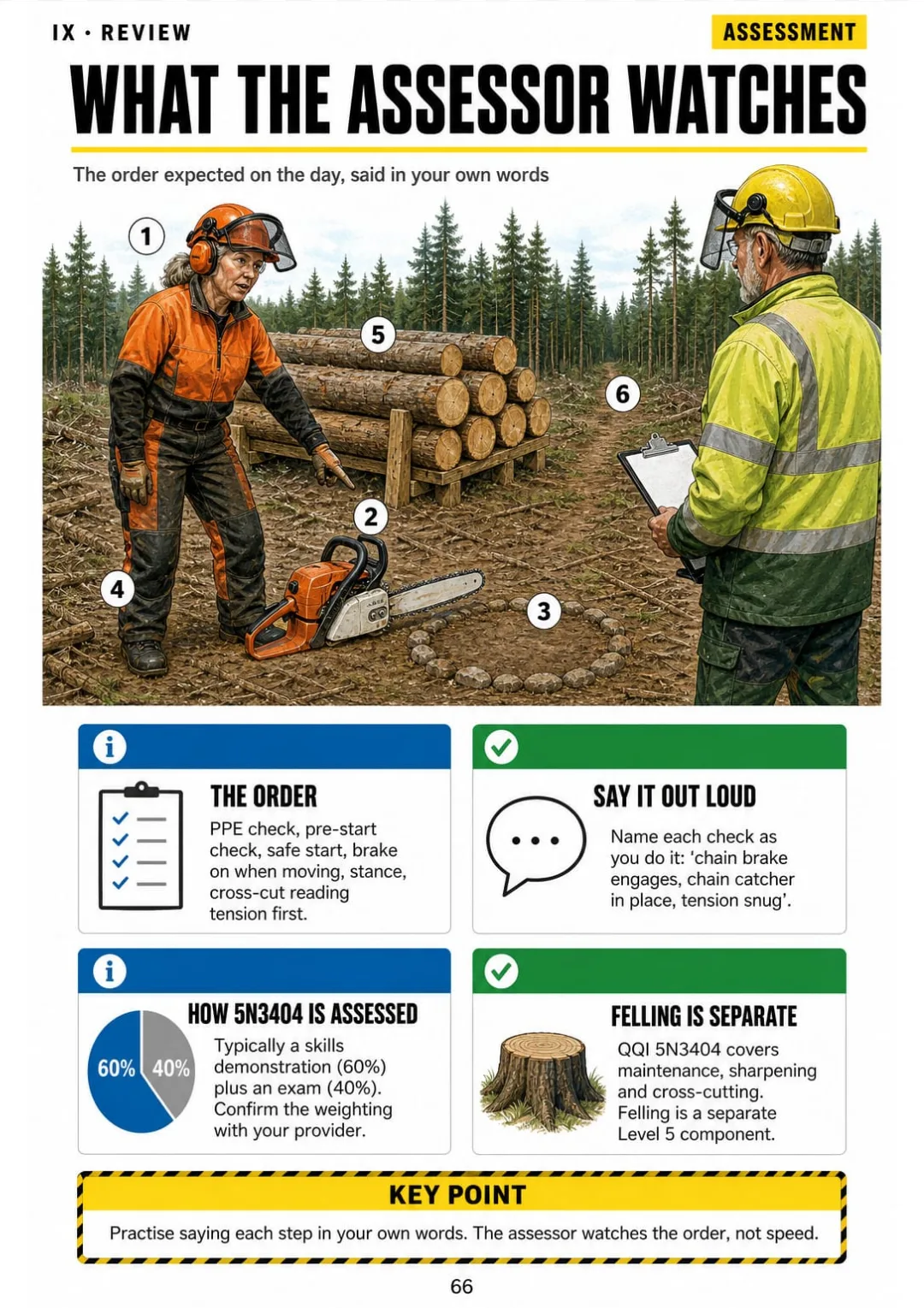
QQI 5N3404: typically 60% skills demonstration, 40% exam, check with your provider
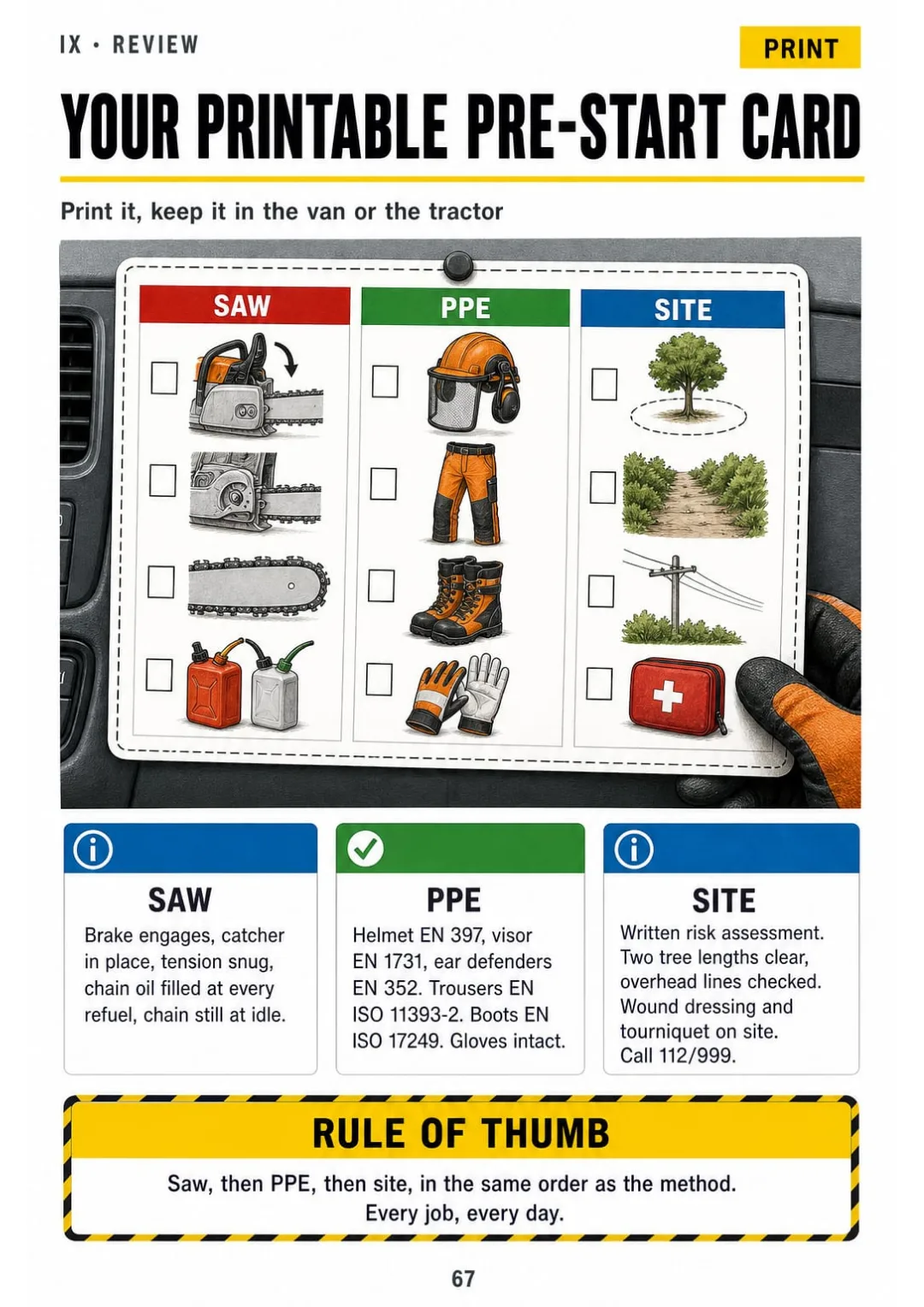
Saw, PPE and site checks on one printable card

Swipe to see more →

These are real pages from the book. The table of contents is the full one: 9 parts and 63 topics.

The Problem Isn't You. It's How It Was Explained to You.

You're at the back of the van with a can of petrol and a bottle of two-stroke oil. The instructor asks how much oil goes into five litres at 50:1, and your mind goes blank.

The course notes cover it, somewhere in a paragraph about ratios, fuel quality and storage. You read it last night and nothing stuck, because it was only ever words.

50:1 = 20 ml of two-stroke oil per litre of petrol; fresh mix, labelled can

In the book it's one page: a litre of petrol with 20 ml of two-stroke oil measured beside it, a labelled can and a reminder to mix it fresh. Five litres? You see 100 ml before you've done the sum.

Chain oil, refuelling and moving 3 metres away, chain tension, file height and the kickback zone each have their own page too.

You understand it, and you do it without going back to the notes. The ratio in your saw's manual comes first, and the page reminds you to check it.

COMPARE FOR YOURSELF

The Same Topic, Two Ways to Study It

THIS
  • The course notes: line after line
  • Trousers, kickback and the hinge explained only in words
  • Class, chain speed, repaired pairs: you look it all up again
Leg protection for chainsaw operators incorporates multiple layers of long, loosely woven synthetic fibres beneath the outer fabric. Upon contact with a moving saw chain, these fibres are drawn out of the garment and carried into the drive sprocket, where they accumulate and arrest the rotation of the chain. Garments are tested to EN 381-5 or EN ISO 11393-2, Class 1 corresponding to a chain speed of 20 m/s. Protection may not be afforded where the protective layers have previously been cut, repaired or otherwise compromised.
FOR THIS
  • How the fibres stop the chain, in one drawing
  • The standards and the numbers in a box
  • Class 1 = 20 m/s, and a cut or repaired pair no longer protects
Clogging fibres jam the sprocket: EN 381-5 or EN ISO 11393-2, Class 1 = 20 m/s.
CONTENTS

Take a Look at the 9 Parts and 63 Topics

The saw and the rules, protective gear, maintenance and pre-start checks, filing the chain, starting and handling, cross-cutting and snedding, felling, hazards and emergencies, and assessment day: 67 pages, all illustrated.

IThe Saw and the Rules · pp. 5-10
  1. The Parts of a Chainsaw, Named
  2. The Safety Features You Check Every Day
  3. Inside the Chain: Cutter, Depth Gauge, Drive Link
  4. The Kickback Zone: The Upper Quarter of the Bar Nose
  5. Who Is Responsible: The Law in Ireland
  6. Noise and Vibration: The Numbers That Matter
IIProtective Gear · pp. 11-16
  1. Head: Helmet, Visor and Ear Defenders
  2. Chainsaw Trousers: How the Fibres Stop the Chain
  3. Boots: Chainsaw Protection and Steel Toecap
  4. Gloves, Jacket and High Visibility
  5. Inspecting Your PPE Before Each Job
  6. The Personal First Aid Kit You Carry
IIIMaintenance and Pre-Start Checks · pp. 17-24
  1. Mixing Two-Stroke Fuel
  2. Chain Oil: Fill It Every Time You Refuel
  3. Refuelling Safely, Then Move 3 Metres
  4. Chain Tension: Snug, Cold and Checked by Hand
  5. Bar Care: Groove, Oil Holes, Burrs
  6. Sprocket and Clutch: When to Replace
  7. Air Filter, Spark Plug and Cooling Fins
  8. Pre-Start Check in the Same Order Every Time
IVFiling the Chain · pp. 25-31
  1. Know Your Chain: Pitch and File Size
  2. Setting Up to File Safely
  3. File Height: One-Fifth Above the Top Plate
  4. The Filing Angle: 30° on Top, Level Stroke
  5. All Cutters the Same Length
  6. Depth Gauges: The Gap That Sets the Bite
  7. Signs of a Blunt or Damaged Chain
VStarting and Handling · pp. 32-38
  1. Ground Start: Brake On, Foot in the Handle
  2. Leg-Lock Start
  3. Never Drop-Start the Saw
  4. After Starting: Idle, Brake and Throttle Checks
  5. Grip and Stance: Thumb Wrapped, Body Off the Line
  6. Carrying the Saw and the 5-Metre Zone
  7. Pulling Chain and Pushing Chain
VICross-Cutting and Snedding · pp. 39-46
  1. Tension and Compression: Read the Log First
  2. Log Lying on the Ground
  3. Log Supported at Both Ends
  4. Log Supported at One End
  5. Working on a Slope: Always Stand Uphill
  6. The Bore Cut: Entering With the Lower Nose
  7. Snedding: The Trunk Between You and the Chain
  8. Branches Under Tension and Spring Poles
VIIFelling · pp. 47-58
  1. Assessing the Tree Before You Touch It
  2. The Danger Zone: Twice the Tree's Height
  3. Escape Routes at 45° Behind the Tree
  4. Clearing the Base and Choosing the Direction
  5. The Notch: Depth and Angle
  6. Notch Types: Conventional, Open Face, Humboldt
  7. The Hinge: The Part You Never Cut
  8. The Back Cut and the Step
  9. Wedges and the Felling Lever
  10. Small Trees Thinner Than the Bar
  11. Forward-Leaning Trees and Splitting
  12. Hung-Up Trees: What You Never Do
VIIIHazards and Emergencies · pp. 59-62
  1. Overhead Lines and Underground Services
  2. Windblown Trees and Root Plates
  3. Working Alone: Your Emergency Plan
  4. A Chainsaw Cut: First Minutes
IXReview and Assessment Day · pp. 63-67
  1. The Whole Sequence on One Page
  2. Numbers to Know
  3. The Most Common Mistakes, Side by Side
  4. What the Assessor Watches
  5. Your Printable Pre-Start Card

One Page, One Topic, All Clear

Think of it this way:

It's assessment day. The assessor points at a leaning ash and asks you to show where the notch goes, how thick the hinge stays and which way you step out.

In the book you open the hinge page and see the stump drawn from the side: the notch, a hinge about one-tenth of the diameter, even along its length, never cut through.

Sned from base to top, stand on the left, rest the saw on the trunk.

The same goes for the kickback zone, the ground start, tension and compression, and escape routes at 45° behind the tree: each one on its own page.

Chainsaw Operations Illustrated is 9 parts and 63 topics, all drawn, and at the end the whole sequence on one page, the numbers to know and a printable pre-start card.

What you see drawn, you don't have to memorize.

What's Inside Chainsaw Operations Illustrated:

Ipp. 5-10

The Saw and the Rules

The parts of the saw, the daily safety features, the chain up close, the kickback zone, who is responsible under Irish law, and noise and vibration.

IIpp. 11-16

Protective Gear

Helmet, visor and ear defenders, chainsaw trousers and boots, gloves and high visibility, checking your PPE, and the first aid kit you carry.

IIIpp. 17-24

Maintenance and Pre-Start Checks

Two-stroke mix, chain oil, safe refuelling, chain tension, bar, sprocket and clutch, filter and plug: so you do the pre-start check in a fixed order without opening the notes.

IVpp. 25-31

Filing the Chain

Pitch and file size, setting up safely, file height, the 30° filing angle, equal cutters, depth gauges and the signs of a blunt chain.

Vpp. 32-38

Starting and Handling

Ground start, leg-lock start, why never to drop-start, the checks after starting, grip and stance, carrying the saw and the 5-metre zone.

VIpp. 39-46

Cross-Cutting and Snedding

Reading tension and compression, logs on the ground or supported, working on a slope, the bore cut, snedding and spring poles.

VIIpp. 47-58

Felling

Assessing the tree, the danger zone, escape routes, the notch and its types, the hinge, the back cut, wedges, leaning and hung-up trees: so you can show where the notch goes, how thick the hinge stays and which way you step out.

VIIIpp. 59-62

Hazards and Emergencies

Overhead lines and underground services, windblown trees and root plates, working alone and the first minutes after a chainsaw cut.

IXpp. 63-67

Review and Assessment Day

The whole sequence on one page, the numbers to know, common mistakes side by side, what the assessor watches and a printable pre-start card.

At the end of the book: The whole sequence on one page, the numbers to know, common mistakes side by side and a printable pre-start card.
Plus: 2 Free Books

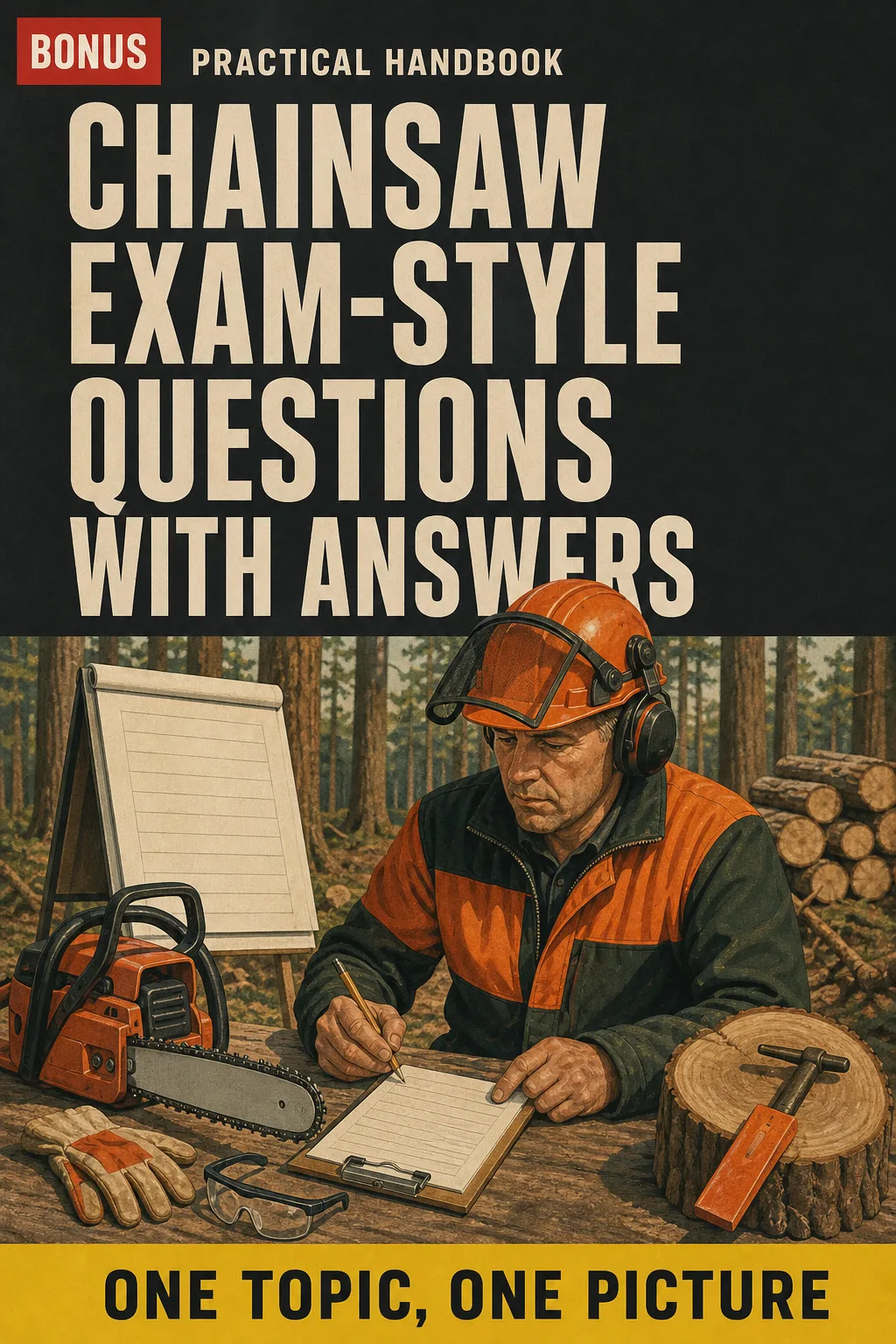
Chainsaw Exam-Style Questions with Answers

BONUS 1: «Chainsaw Exam-Style Questions with Answers»

Value on its own: US$ 17.90

Test yourself topic by topic before the course and see exactly which step you still mix up, with every answer explained.

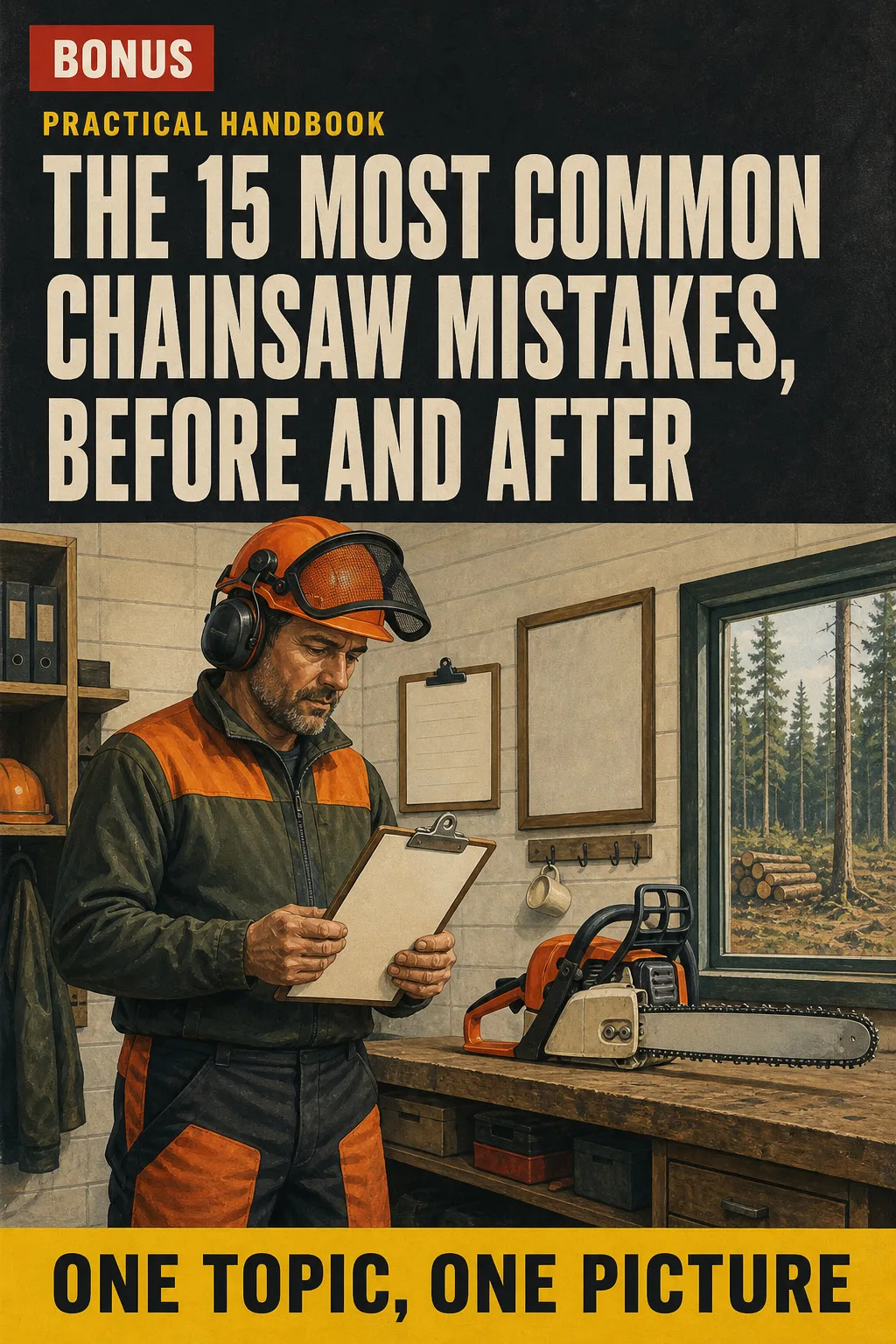
The 15 Most Common Chainsaw Mistakes, Before and After

BONUS 2: «The 15 Most Common Chainsaw Mistakes, Before and After»

Value on its own: US$ 14.90

See the wrong way and the right way side by side, from a loose chain to a back cut that's too low, so you spot them on the day.

Chainsaw Operations Illustrated with 2 Free Books

  • Chainsaw Operations Illustrated: 67 illustrated pagesUS$ 63
  • BONUS 1: Chainsaw Exam-Style Questions with AnswersUS$ 17.90
  • BONUS 2: The 15 Most Common Chainsaw Mistakes, Before and AfterUS$ 14.90
  • High-resolution PDF to printIncluded
Total value US$ 95.80
YOUR PRICE:
US$ 27
You save US$ 68.80
YES, I WANT CHAINSAW OPERATIONS ILLUSTRATED FOR US$ 27

📄 This is a digital PDF book sent to your email: nothing is printed or shipped.

Secure purchaseEncrypted payment30-day guarantee

PDF by email: We email you Chainsaw Operations Illustrated as a PDF, together with the two free books. It's a single payment: no installments, no extra charges.

Who This Book Is For

You're doing the QQI Level 5 course

You're doing the QQI Level 5 course

Each session has its page: you read the drawing the night before and arrive knowing what the instructor is talking about.

Your assessment is coming up

Your assessment is coming up

The whole sequence on one page and the numbers to know, to go over it all in one evening, in the same order the assessor watches.

You already work with the saw

You already work with the saw

Filing angles, depth gauges and felling cuts drawn, to check your own habits and work more safely on the farm or the job.

Everything You Get Today

US$ 95.80US$ 27
YES, I WANT CHAINSAW OPERATIONS ILLUSTRATED FOR US$ 27

📄 This is a digital PDF book sent to your email: nothing is printed or shipped.

30DAYS
GUARANTEE

30-Day Guarantee

Try Chainsaw Operations Illustrated for 30 days, bonus books included.

We refund everything if the file won't open, if the book isn't what you see here, if you were charged twice or if the email doesn't arrive. Just email us.

You pay once. No subscriptions.

Frequently Asked Questions

Is it for me if I've used a saw for years but haven't studied in decades?

Yes. It doesn't teach you to hold a saw: it puts what the course asks for in order, one drawn page per topic, so you can explain each step in your own words.

Where does the content come from?

From HSA guidance on chainsaw and tree work, the Safety, Health and Welfare at Work Act 2005, the 2007 General Application Regulations, the topics of the QQI Level 5 Chainsaw Operations course and the manufacturer's operator manual. It's written for Ireland, not the UK, and covers the core topics of chainsaw courses and assessments here, whether QQI or City & Guilds NPTC: maintenance, cross-cutting and felling.

Is it official material?

No. It's independent study material. It isn't published, approved or endorsed by QQI, City & Guilds, NPTC or the HSA.

Does it replace the course?

No, and it doesn't give you a certificate or a qualification: that comes only from the course and the assessment. The instructor shows you each step once, on the day. The book is for the evening after and the night before: the numbers and the order, one drawn page per topic, so you can go over them as often as you need.

Are the practice questions the ones in the assessment?

No. They're written for this book to help you test yourself topic by topic. They aren't official questions from any exam or assessment.

When and how does it arrive?

As a PDF by email, to the address you enter at checkout. The 2 free books come the same way.

Do I have to pay every month?

No. It's a single payment, with no subscription.

Can I have it on paper?

Yes. The PDF is made to print at home or in a print shop, so you can keep it in the van or bring it to the course.

How does the refund work?

You have 30 days. We refund everything if the file won't open, if the book isn't what you see on this page, if you were charged twice or if the email doesn't arrive: just email us.

Before You Close This Page

No more rereading course notes that don't stick.

The notch, the hinge and the escape route: you see them drawn and that's it.

You get to the assessment knowing where everything is.

Drawings make studying faster.

The book is right below.

One-time payment: US$ 27 · Guarantee: 30 days · PDF by email

YES, I WANT CHAINSAW OPERATIONS ILLUSTRATED FOR US$ 27

📄 This is a digital PDF book sent to your email: nothing is printed or shipped.